
NHS Dental Cost & Eligibility Checker
Enter your details below to determine if you are exempt from NHS dental charges or which band applies to common treatments.
Assessment Result
Estimated Patient Charge:
£0.00
Imagine walking into a dentist with a broken tooth or missing implant and paying nothing. Sounds too good to be true? For many people in the UK, it actually is possible. But here is the catch: "free" doesn't mean everyone gets it, and it definitely doesn't mean you can just walk in and ask for a Hollywood smile at no cost. The system is complex, rules are strict, and if you don't know where to look, you might miss out on thousands of pounds in savings.
You want to fix your teeth without draining your bank account. Maybe you have a painful abscess, a chipped front tooth, or you need an NHS dental implant because your natural root is gone. You are likely wondering if the National Health Service (NHS) covers this, who qualifies, and what the actual process looks like. This guide cuts through the bureaucratic noise. We will break down exactly who gets free treatment, why implants are rarely free, and how you can legally lower your bill to zero.
The Reality of Free Dental Treatment on the NHS
First, let's clear up a massive misconception. The NHS does not provide free dental care for everyone. It provides subsidized care for specific groups. If you fall outside these groups, you pay standard fees set by the government. These fees are updated annually, but as of late 2025/early 2026 trends, they remain tiered into three bands.
NHS Dental Charges are the fixed fees patients pay for dental treatments provided under the National Health Service in England, which vary based on the complexity of the procedure. Also known as NHS Bands, they were introduced to help fund the service while keeping costs predictable for patients.
If you are exempt from charges, you pay £0. Who is exempt?
- Children under 18.
- Young people under 19 who are in full-time education.
- Pregnant women and those who have had a baby in the last 12 months.
- People receiving certain benefits, such as Income Support, Jobseeker’s Allowance, or Pension Credit Guarantee Credit.
- Those named on a valid HC2 certificate (full help) issued by the NHS Business Services Authority.
If you do not fit these categories, you pay. And yes, that includes most adults needing major work. But wait-does "free" cover everything? No. Even if you are exempt from charges, you still need a referral for specialist work like implants. More on that later.
What Counts as "Fixing" Your Teeth?
When you say "fix my teeth," you might mean different things. A filling? A crown? An implant? The NHS treats these differently.
Dental Restoration is a procedure used to repair damaged teeth, ranging from simple fillings to complex crowns and bridges. Unlike cosmetic dentistry, restoration focuses on function and health rather than aesthetics alone.
The NHS follows a principle called "minimum necessary intervention." They will fix your tooth using the cheapest option that works clinically. If a filling solves the problem, they won't give you a crown. If a bridge works, they won't offer an implant unless specific criteria are met. This is crucial to understand because private clinics often push for implants immediately, while the NHS tries to save money and bone structure.
Here is how the bands work for non-exempt patients:
| Band | Includes | Approximate Cost (England) |
|---|---|---|
| Band 1 | Examination, diagnosis, advice, X-rays | £26.80 |
| Band 2 | Everything in Band 1 plus fillings, extractions, scaling | £73.50 |
| Band 3 | Everything in Band 1 & 2 plus crowns, dentures, bridges | £319.10 |
Notice something missing? Implants are not listed. That is because standard NHS contracts usually do not cover routine implants. They cover bridges and dentures instead. So, if you get your teeth "fixed" on the NHS, you are likely getting a bridge or denture, not an implant, unless you qualify for special funding.
Can You Get NHS Dental Implants for Free?
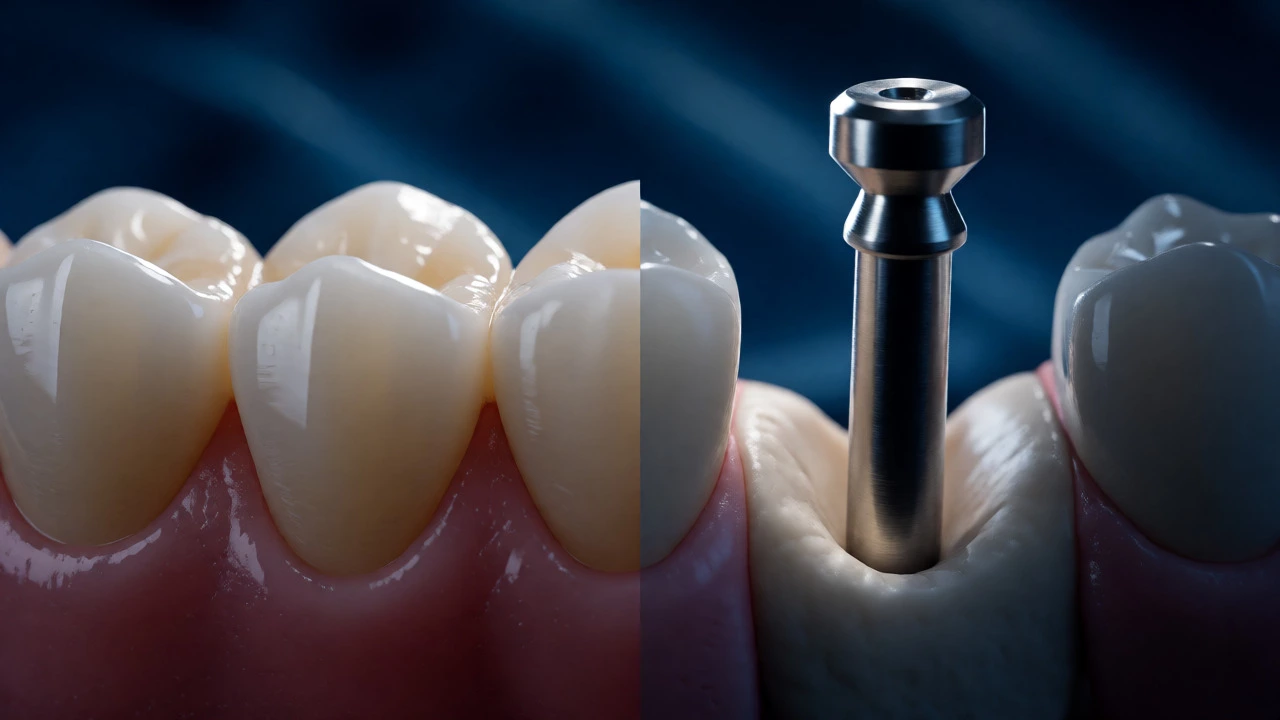
This is the big question. Technically, yes, but it is rare. NHS Dental Implants are titanium screw-like posts surgically placed into the jawbone to support a replacement tooth, funded by the state only in exceptional clinical circumstances.
The NHS considers implants expensive. They prefer bridges because they are cheaper. To get an implant funded, you must prove that a bridge or denture would fail or cause significant harm. Common reasons include:
- Congenital Absence: You were born without certain teeth (e.g., lateral incisors).
- Trauma: You lost teeth due to an accident, especially if you are young.
- Ectodermal Dysplasia: A genetic condition affecting teeth development.
- Mouth Cancer Reconstruction: Following surgery for oral cancer.
If you meet these criteria, your GP or dentist can refer you to a hospital-based dental department. If approved, the implant itself and the fitting are free. However, the crown attached to the implant might still incur a Band 3 charge unless you are fully exempt. Always check with the referring clinic.
How to Access Free Treatment via HC2 Certificates
If you are not a child or pregnant, your best route to free care is financial. The NHS Low Income Scheme offers two levels of help: HC2 (full help) and HC3 (partial help). Getting an HC2 certificate means you pay nothing for prescriptions, dental care, glasses, and travel to hospitals.
To apply, you need to fill out form HC1. It asks about your income, savings, and expenses. Many people assume they earn too much, but the thresholds are surprisingly generous if you have dependents or high housing costs. For example, if you are single, earning less than £20,000 a year (after tax) might qualify you for full help, depending on your capital and expenses. If you have children, the threshold rises significantly.
Pro tip: Do not lie on the form. The NHS Business Services Authority checks against HMRC data. If you claim free treatment and cannot produce a valid HC2 certificate when asked, you will be charged privately rates, which are much higher.
Alternatives: Charities and Teaching Hospitals
What if you do not qualify for NHS exemptions but cannot afford private fees? Look beyond the standard GP dentist.
Dental Schools are educational institutions training future dentists, offering reduced-cost treatment supervised by qualified professionals.
While not always free, university dental hospitals often charge 30-50% less than private practices. Treatments take longer because students are learning, but the quality is high because professors supervise every step. If you are open to waiting weeks for appointments, this is a viable middle ground.
For truly free options, consider charities. Organizations like Smile Train or local charitable trusts sometimes run campaigns for cleft lip/palate repairs or emergency extractions for homeless individuals. Additionally, some community health centers in deprived areas receive extra funding to waive fees for vulnerable residents. Check with your local council’s public health team.

Step-by-Step: How to Claim Your Free Treatment
Ready to try? Here is your action plan.
- Check Eligibility: Are you under 18, pregnant, or on benefits? If yes, go to step 4.
- Apply for HC2: Download form HC1 from the NHS website. Fill it out honestly. Send it off. Wait 4-6 weeks for approval.
- Find an NHS Dentist: Use the NHS "Find a Dentist" tool. Call them. Ask explicitly: "Are you accepting new NHS patients?" Many are oversubscribed.
- Book an Examination: Tell them you have an HC2 certificate or are exempt. Bring proof (birth certificate, pregnancy mat B1, benefit letter, or HC2 cert).
- Discuss Options: If you need an implant, ask: "Do I qualify for NHS-funded implants due to trauma or congenital absence?" If they say no, ask for a referral to a hospital dental service.
- Get the Quote: If you are not exempt, ask for the exact band charge before agreeing to treatment. You can refuse Band 3 work and opt for Band 2 alternatives (like extraction instead of a crown) if cost is an issue.
Pitfalls to Avoid
Don't make these common mistakes.
- Assuming all dentists accept NHS patients: In many parts of London and the South East, finding an NHS dentist is harder than finding a parking spot. Start looking months in advance.
- Ignoring the "Cosmetic" label: If you want straighter teeth for looks, not function, the NHS won't touch it. Orthodontics for adults is almost always private unless there is severe functional impairment.
- Forgetting follow-up costs: An implant isn't just one visit. You need maintenance. While the implant might be free, hygiene visits could be charged separately depending on your status.
Final Thoughts: Is It Worth the Effort?
Getting your teeth fixed for free in the UK is possible, but it requires paperwork and patience. If you qualify for HC2, it is straightforward. If you need an implant, it is a battle of medical necessity versus budget constraints. Don't give up if your first dentist says no. Seek a second opinion, especially from a hospital dental department.
Remember, untreated dental issues lead to heart disease, diabetes complications, and chronic pain. Spending time navigating the NHS system is worth it compared to the long-term health risks of ignoring your teeth. And if you truly cannot get NHS help, look into payment plans offered by private clinics-they are better than letting decay spread.
Are dental implants free on the NHS?
Generally, no. NHS contracts typically cover bridges and dentures. Implants are only funded in exceptional cases, such as congenital absence, trauma, or following mouth cancer reconstruction. You must be referred by a dentist to a hospital dental service for assessment.
Who qualifies for free dental treatment in the UK?
Children under 18, full-time students under 19, pregnant women, new mothers within 12 months of birth, and people receiving specific benefits (like Income Support) or holding a valid HC2 certificate for low income.
How much does a crown cost on the NHS?
A crown falls under Band 3. As of recent updates in England, this costs approximately £319.10. This fee covers the examination, preparation, and placement of the crown. Prices may vary slightly in Scotland, Wales, and Northern Ireland.
Can I get free braces as an adult?
Rarely. Adult orthodontics is usually considered cosmetic and is not covered by the NHS unless there is a severe functional issue, assessed using the Index of Orthodontic Treatment Need (IOTN). Most adults pay privately or use payment plans.
What is an HC2 certificate?
An HC2 certificate is part of the NHS Low Income Scheme. It proves you are eligible for full help with health costs, meaning you pay £0 for dental treatment, prescriptions, and other services. You apply via form HC1.