

Private Healthcare Time & Cost Calculator
Comparison Results
Estimated Private Cost
Disclaimer: This is an estimate based on UK healthcare data. Actual costs and wait times may vary depending on your location, condition, and provider. Private healthcare is not a replacement for emergency NHS services.
When you’re waiting months for an NHS appointment, or stuck in a waiting room with a worsening condition, it’s no wonder so many people in the UK start asking: what are the perks of going private? It’s not just about luxury rooms or private bathrooms. It’s about control, speed, and peace of mind when your health is on the line.
Speed That Actually Matters
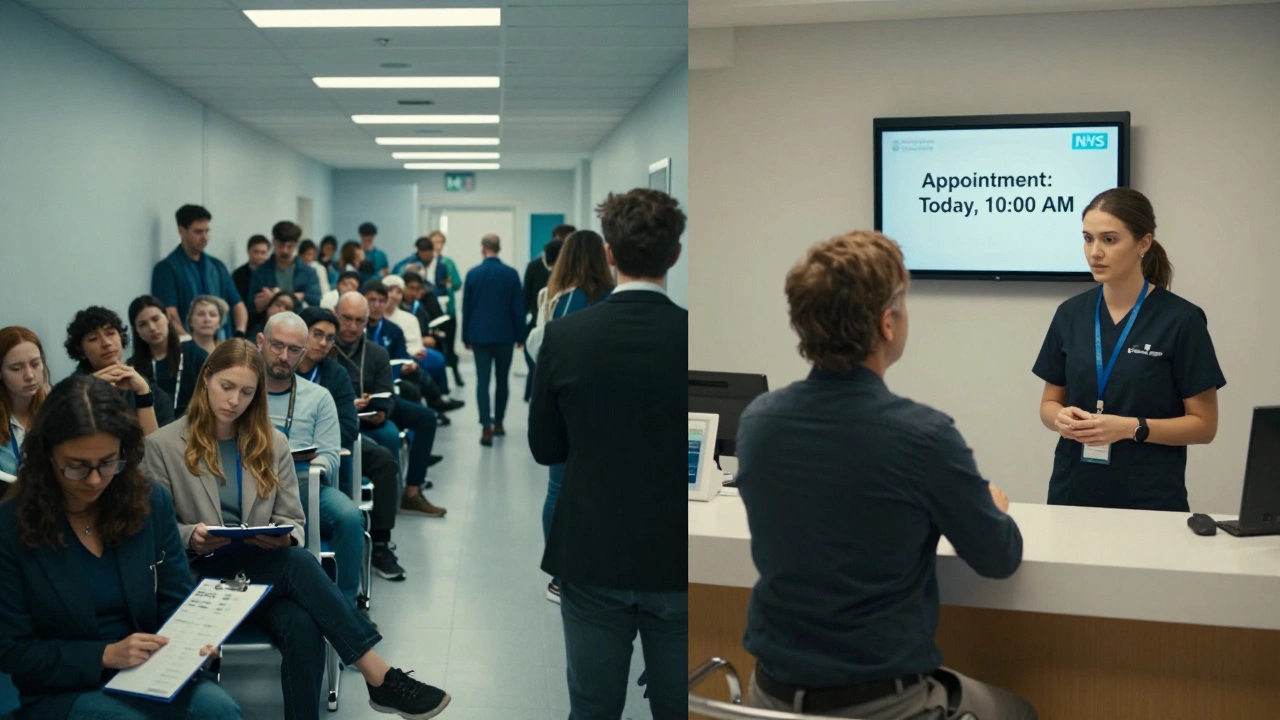
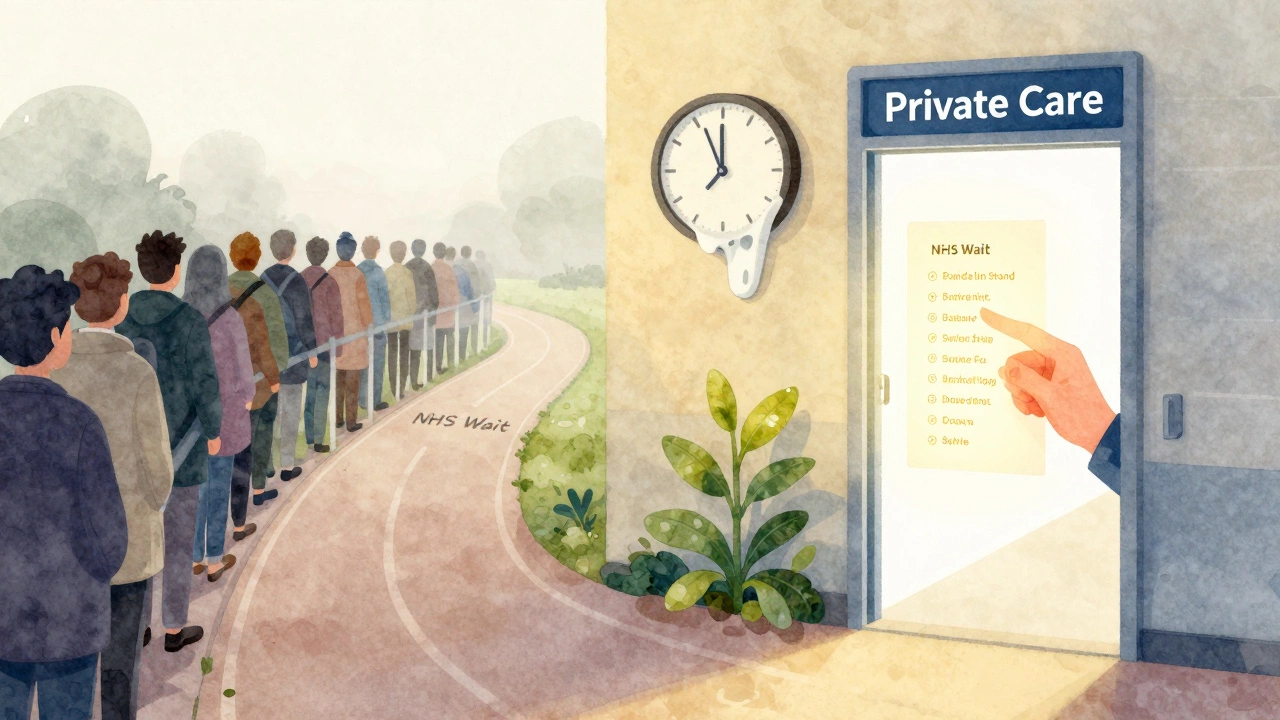
Time isn’t just money when it comes to health-it’s function, comfort, and sometimes life. The NHS backlog still lingers, with over 7.5 million people waiting for treatment as of late 2025. Private healthcare cuts through that. For a routine knee scan, you might wait 12 weeks on the NHS. In private care, it’s often 48 hours. A consultant appointment? Same day or next day, not six weeks.
This isn’t theoretical. A 2024 study by the King’s Fund tracked 2,000 patients who switched from NHS to private care for hip replacements. The average wait time dropped from 14 weeks to 9 days. That’s not a bonus-it’s a game-changer for someone in constant pain.
Choice You Can Actually Use
On the NHS, your consultant is assigned based on availability. In private care, you pick. You can research specialists, read patient reviews, and choose someone with a track record in your exact condition. Want the surgeon who’s done 300 successful spinal fusions in the last year? You can find them. Want to see a consultant who speaks your language or shares your cultural background? That’s built into the system.
Private hospitals also let you choose your hospital. Some specialize in complex cases. Others have better recovery suites or more experienced physio teams. You’re not stuck with the nearest one. You’re not told, ‘We’re fully booked until April.’ You’re given options-and the power to decide.
Personalized Care That Doesn’t Feel Like a Number
NHS staff work incredibly hard, but they’re stretched thin. A typical GP appointment lasts 10 minutes. A private consultation? 30 to 60 minutes. That’s not a luxury-it’s the difference between a rushed diagnosis and a real conversation.
Private providers track your history across visits. They remember your allergies, your preferences, your fears. They don’t just treat your MRI results-they ask how your sleep’s been, if the pain’s changed since last week, whether you’ve been able to play with your kids. That kind of attention leads to better outcomes. A 2023 survey by the Private Healthcare Information Network found that 87% of private patients felt their doctor truly listened to them, compared to 52% on the NHS.
No Hidden Delays or Bureaucratic Bottlenecks
On the NHS, getting a referral, waiting for approval, filling out forms, and then waiting again for a slot? It’s a process. Private care removes most of that. You call, you book, you show up. No internal referrals needed. No waiting for funding committees. No being told, ‘We can’t do that here, try another hospital.’
Private clinics handle everything in-house: diagnostics, surgery, rehab. One location. One team. One timeline. If you need a blood test on Monday, a scan on Tuesday, and a follow-up on Wednesday, it happens. No jumping between departments. No lost paperwork. No ‘we’ll call you when we can.’
Access to Treatments the NHS Won’t Fund
The NHS has to make tough choices. Some treatments are deemed too expensive, not cost-effective, or still under review. That doesn’t mean they don’t work. It just means they’re not available on the public system.
Private care gives you access to newer therapies-like focused ultrasound for essential tremor, advanced stem cell injections for joint repair, or cutting-edge robotic-assisted surgery for prostate cancer. These aren’t experimental. They’re proven. But they’re not funded by the NHS because the cost-per-outcome ratio doesn’t meet their thresholds. In private care, you’re not denied because of budget lines-you’re offered because you can access them.
Comfort That Supports Healing
Recovery isn’t just about medicine-it’s about environment. Private hospitals have single rooms. No shared bathrooms. No noise from other patients. No 6 a.m. ward rounds with a team of 10 people. You get quiet, privacy, and better food. Some even offer in-room physio, massage therapy, and nutritional coaching.
Studies show that stress slows healing. A quiet, calm recovery space reduces cortisol levels. Lower stress means faster recovery times. One 2025 report from the Royal College of Surgeons found that private patients returned to normal activity 30% faster after minor surgery than their NHS counterparts-even when the procedures were identical.
Continuity of Care After Discharge
Leaving the hospital is often the hardest part. On the NHS, you get a discharge letter and a referral to community services-then you’re on your own. Private care includes follow-up. Your consultant calls you a week after surgery. Your physio checks in. Your nurse texts you to see how the wound’s healing. You’re not just a patient-you’re a person in a care plan.
Many private providers offer 24/7 helplines staffed by clinicians. If you’re worried about a symptom at 2 a.m., you can call and speak to a doctor-not an automated system, not a call center. That kind of access reduces anxiety and prevents unnecessary A&E visits.
It’s Not Just for the Wealthy
People assume private healthcare is only for millionaires. It’s not. Many employers offer private health insurance as a benefit. Others pay for it monthly through flexible plans-sometimes as little as £30 a month for basic coverage. You don’t need a luxury package to get faster scans, shorter waits, or better access.
Even without insurance, many private clinics offer fixed-price packages for common procedures: £1,200 for a knee arthroscopy, £1,800 for a hernia repair. You know the cost upfront. No surprise bills. No hidden charges. That’s transparency you won’t always get on the NHS.
When Private Care Makes the Most Sense
Private healthcare isn’t a replacement for the NHS-it’s a complement. But there are moments when it’s the smarter choice:
- You have chronic pain that’s getting worse and NHS wait times are dragging on.
- You need a specialist opinion and can’t wait months for an NHS referral.
- You’re planning surgery and want to control the timing-maybe to avoid missing work or family events.
- You’ve had a negative experience with the NHS and want more control over your care.
- You’re managing a complex condition and need coordinated, consistent follow-up.
If your condition is urgent or life-threatening, the NHS is still the fastest route. But for everything else? Private care gives you back agency. And that’s worth more than most people realize.
What Private Healthcare Doesn’t Do
Let’s be clear: private care doesn’t cure cancer faster. It doesn’t replace emergency services. It doesn’t make you invincible. It doesn’t guarantee a miracle. What it does is remove the friction-waiting, uncertainty, lack of choice-that makes healthcare feel like a battle instead of a partnership.
It’s not about being ‘better’ than the NHS. It’s about being different. And for many, that difference is everything.
Is private healthcare worth it if I have NHS coverage?
Yes-if you value speed, choice, and control. The NHS provides excellent emergency and critical care. But for non-urgent conditions, waiting times, limited specialist access, and lack of personalization can delay recovery. Private care removes those barriers without replacing the NHS.
Can I use private care without insurance?
Absolutely. Many private clinics offer transparent, fixed-price packages for common procedures like joint injections, hernia repairs, or diagnostic scans. You pay upfront, and there are no hidden fees. Some even offer payment plans.
Does private care mean better doctors?
Not necessarily. Many private consultants also work for the NHS. The difference isn’t skill-it’s time. Private doctors spend longer with each patient, have smaller caseloads, and aren’t juggling 30 appointments a day. That leads to more accurate diagnoses and better follow-up.
Are private hospitals safe?
Yes. All private hospitals in the UK are regulated by the Care Quality Commission (CQC), just like NHS hospitals. They must meet the same safety and hygiene standards. Many exceed them because they’re designed for efficiency and patient comfort, not just cost control.
Can I switch back to the NHS after using private care?
Yes. There’s no rule that locks you in. Many people use private care for a specific procedure, then return to the NHS for ongoing management. Your private records can be shared with your GP if you give consent. It’s a flexible system.