Surgery Funding & Eligibility Checker
Answer a few questions to understand which funding path (Public, Private, or Trial) best matches your current situation based on medical guidelines.
The Big Divide: Cosmetic vs. Reconstructive
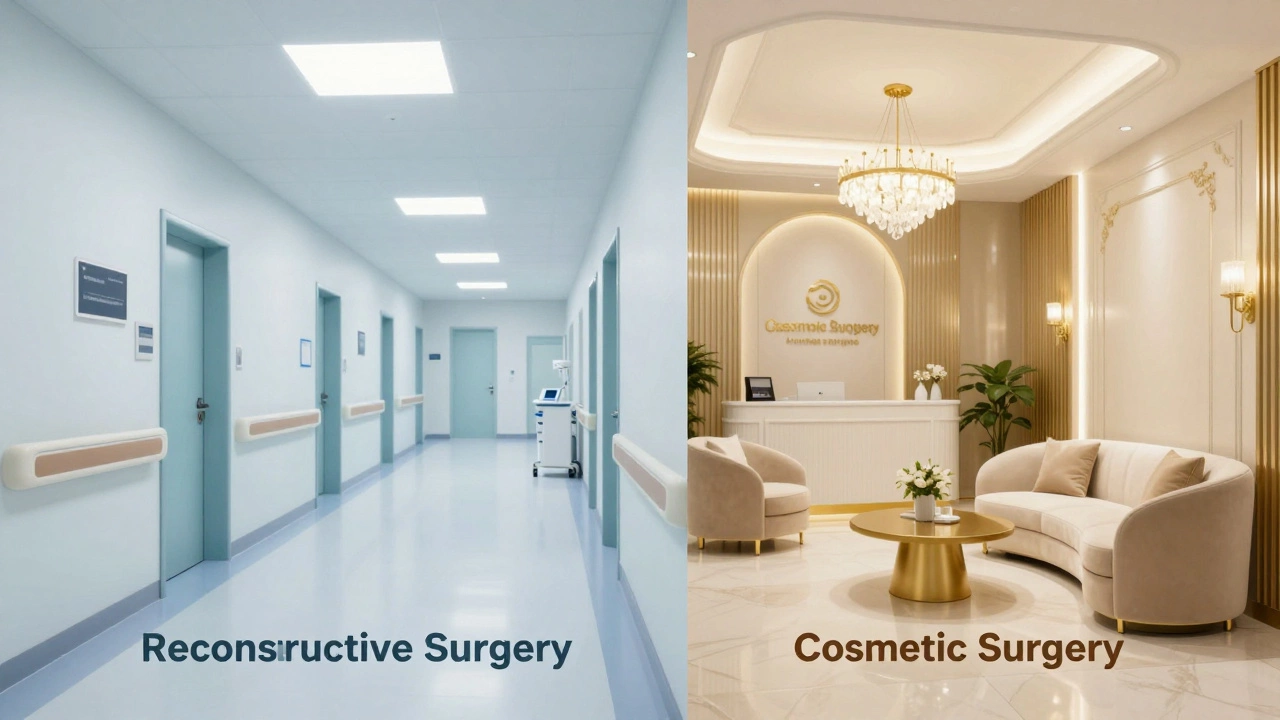
To understand why you won't find a 'free cosmetic surgery' capital of the world, we have to look at what doctors are actually doing. In the UK, the NHS (National Health Service) is the gold standard for free healthcare. But the NHS is a publicly funded healthcare system that prioritizes medical necessity over vanity. If you have a cleft lip from birth, severe burns from an accident, or breast cancer that requires reconstruction, the government sees that as a health requirement. In these cases, the surgery is free. But if you want a rhinoplasty because you don't like the shape of your nose, you'll be pointed straight toward a private clinic. The same logic applies in Canada, Germany, and Scandinavia. These countries have robust public health systems, but they aren't in the business of funding aesthetic upgrades.How it Works in the UK
For those living in the UK, navigating the line between 'cosmetic' and 'reconstructive' can be frustrating. You might think your eyelid surgery is purely aesthetic, but if your skin is drooping so much that you can't see, it becomes a medical necessity called blepharoplasty.Here is how the cosmetic surgery UK landscape typically breaks down for patients:
- NHS Route: Completely free if the procedure is deemed 'medically necessary.' This includes treating congenital deformities or trauma. However, the waiting lists can be brutal, sometimes stretching for years.
- Private Route: You pay for everything. You get a faster timeline, more choice in your surgeon, and access to the latest luxury clinics in Harley Street.
- Insurance Route: Very few standard health insurance policies cover aesthetic work, though some high-end plans might cover specific reconstructive needs after an accident.
The 'Free' Trap: Clinical Trials and Medical Schools
Since no government is paying for your liposuction, where do the stories of 'free surgery' come from? Usually, it's through Clinical Trials. When a pharmaceutical company develops a new filler or a medical device company creates a new implant, they need human subjects. In some rare cases, they might offer the procedure for free in exchange for your data and follow-up visits. Then there are teaching hospitals. In some countries, surgeons-in-training need to complete a certain number of procedures to get certified. While the surgery itself might be discounted or free, you are essentially acting as a practice mannequin. This comes with a huge risk: you aren't paying for the surgeon's expertise, but you are paying with your safety. If something goes wrong, the 'free' price tag becomes the most expensive mistake of your life.| Option | Cost | Who Qualifies? | Primary Risk |
|---|---|---|---|
| Public Health (NHS/Canada) | Free | Medically necessary cases | Extremely long wait times |
| Private Clinics | High | Anyone with the budget | Varying quality of surgeons |
| Clinical Trials | Free/Low | Specific trial criteria | Experimental side effects |
| Medical Tourism | Moderate | Anyone traveling abroad | Lack of aftercare/regulation |
The Allure of Medical Tourism
Since free surgery doesn't exist for vanity, people turn to Medical Tourism. This is the practice of traveling to countries like Turkey, Thailand, or Mexico to get surgery at a fraction of the cost in the UK or US. It isn't free, but it's cheap. Why is it so much cheaper? It usually comes down to lower labor costs, cheaper real estate for clinics, and different regulatory standards. For example, a full set of veneers or a hair transplant in Istanbul might cost 70% less than in London. But here is the catch: if you fly home and your implants leak or you get a severe infection, your local GP in the UK can treat the symptom, but they can't easily undo the work of a surgeon who is 2,000 miles away. You are effectively voiding your 'warranty' by leaving the country where the surgery was performed. The lack of a seamless follow-up chain is the hidden cost of cheap surgery.Red Flags: When 'Free' Means 'Danger'
If you stumble upon a website promising free surgery in exchange for 'promoting' the clinic on social media, stop immediately. These are often 'influencer' deals that look great on Instagram but hide the reality of the recovery. Many of these clinics operate in a legal grey area with minimal oversight. Ask yourself these questions before considering a suspiciously cheap or free offer:- Is the surgeon board-certified by a recognized international body?
- Where is the facility located, and does it have a valid medical license?
- What happens if there is a complication after I fly home?
- Why is the clinic willing to lose thousands of dollars in profit to give me this for free?

Real-World Scenarios: Who Actually Gets it Free?
Let's look at a few concrete examples to clear up the confusion. Sarah was born with a severe cleft palate. In the UK, her entire journey-from the first surgery as an infant to the final refinements in her teens-was handled by the NHS. This was free because it was a functional necessity. Mark, on the other hand, wanted a nose job to remove a bump. He applied for NHS funding, claiming he had breathing issues. The doctors performed an endoscopic exam and found his nasal passages were clear. His request for free surgery was denied because the issue was aesthetic, not medical. Then there is Elena, who joined a study for a new non-invasive skin tightening technology. She received the treatment for free, but she had to visit the clinic every two weeks for six months for blood tests and skin biopsies. She didn't pay money, but she paid in time and medical risk.Are there any countries where cosmetic surgery is free for everyone?
No. There is no country in the world that provides elective cosmetic surgery (surgery for purely aesthetic reasons) for free to the general public. Public health systems only cover reconstructive surgery required for health or function.
How do I qualify for free reconstructive surgery in the UK?
You must be referred by a GP to an NHS plastic surgeon. The surgery must be deemed 'clinically necessary,' meaning it treats a deformity, corrects a birth defect, or repairs damage from an accident or disease (like cancer).
Is medical tourism a safe alternative to expensive UK surgery?
It can be, but it carries higher risks. The main issue is the lack of continuity of care. If complications arise after you return home, you may struggle to find a local surgeon willing to fix a procedure they didn't perform, and the original clinic is no longer accessible.
What is the difference between plastic surgery and cosmetic surgery?
Plastic surgery is the broad umbrella that includes both reconstructive surgery (fixing things) and cosmetic surgery (enhancing things). All cosmetic surgery is plastic surgery, but not all plastic surgery is cosmetic.
Can I get free surgery through a clinical trial?
Yes, some clinical trials offer procedures for free to participants. However, you must meet strict medical criteria, and you are essentially agreeing to be part of an experiment, which carries more risk than a standard procedure.